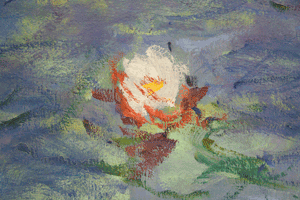
This photo has absolutely nothing to do with Sauternes but we went to L'Orangerie the other day and this was one of the hundreds of individual scenes contained in Monet's eight great murals. A must see in Paris.
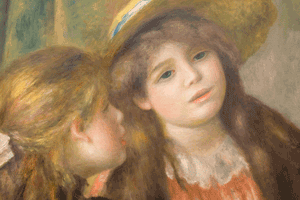
Not only Monets - some great Renoirs, Cezannes, Utrillos and Matisse. This is Renoir's portrait of his two girls.
Sauternaise I am starting to understand that the trick with Sauternaise (the area which produces Sauternes) is to produce a wine with high residual sugar and high alcohol. Quite how the winemakers at Chateau d’Yquem and others do that, I don’t know, because these two things are not brothers in arms: yeast ferments sugars and turns them into alcohol, so that in normal progression, you start with high sugar and low alcohol and end up with low sugar and high alcohol. The common vineyard rot Botrytis Cinerea is certainly one factor in this alchemy. Sauternes are produced in Bordeaux around where the Ciron and Garonne rivers conflux. Apparently, the Ciron is smaller and flows down from the lofty (500 feet) Landes region and is consequently much colder. Their confluence, par conséquent (I use the French version of ‘therefore’ as a precaution against faulty gallic science), results in morning mists during the harvest season and this humidity promotes the growth of Botyritis Cinerea, known locally as noble rot, since it has ennobled vignerons around here for several centuries with profits from the viscous, sweet wines that taste of honey, citrus, nuts and spice and that result when and only when botrytis strikes in the last weeks of the harvest. I can say, from personal experience as well as reading text books, that botrytis has the disarming habit of piercing tiny, invisible holes in grapes and sucking out the liquid content. They absorb the water and, in the process of digestion, return the sugars to the berries. If botrytis strikes at the right time it dehydrates the grapes and adds a distinctive nutty honey flavour. If it happens earlier in the season, the holes in the berries allow less attractive rots in and you end up with mush. For the moment I shall ignore the progress of science that allows vignerons in Sauternaise and elsewhere – even Australia’s Granite Belt – to inoculate their vines with botrytis spores, thus priming the process. This cannot be the only secret of success and certainly not in this area, because they produced fabulous infected wines long before the bloke in the white coat with a hypodermic syringe came along. The French are past masters at surrounding their wine industry in mystery and I am, by nature, a sceptic who looks for rational explanations. Sauternes, however, have so far defeated me. How, for example, do they manage to age such sugary substances in oak barrels for up to three years without acquiring bacterial infections along the way? I do not know, monsieur but I wish I did. We make a dessert wine and the first thing you notice when you do this is the process of dehydrating the berries reduces the harvest massively. We get one eighth of our usual crop when we make this type of wine. In France they have low per hectare yields anyway (3000 litres per hectare is fairly typical) but with Sauternes it is very low – down to 900 litres per hectare on grand cru vineyards which, come to think of it, is only slightly less than we get. |
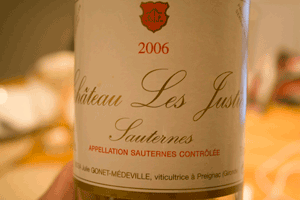
2006 Chateau Les Justices A Julie Gonet-Medeville Sauternes wine, an 8.5 hectares estate near the Ciron and below the Preignac, planted with Semillon, Muscadelle and Sauvignon Blanc. According to their website, the Chateau Les Justices is typically 85 per cent Semillon, 10 per cent Sauvignon and 5 per cent Muscadelle. Harvesting takes up to eight passes through the rows over a one month period, picking berries/bunches which are just right and leaving the rest. The website says the wine is “aged in oak barrels during two years”. This apparently conflicts with what you are told if you press the “more information” button, which produces a document that states: “There are no casks used during ageing or fermentation… because we want to avoid any oak flavours.” I love the French. I feel so at home here. By way of benchmarking, Chateau d’Yquem says on its website that it ferments its wines in the barrel and they are then aged up to three years in oak. I could not find a button saying “more information” so I take this to be true. This is an extraordinary wine though not necessarily a particularly good example of a Sauternes. It is the driest genuinely sweet wine I have ever tasted because it is both. The wine has a honeyed, marmalade, botrytised nose and a lovely mid straw colour compatible with a 2006 wine, yet the palate, when it gets into the mid and back regions, has an amazingly dry structure with what I took to be light oak (before the website confused me) and fruit tannins. It is a massive 14 per cent alcohol, which possibly explains why it is so dry on the back – but how do they do this? Je ne comprends pas. This sort of alcohol level is not uncommon for Sauternes wines. Denice and I drank this over several days – it is too sweet for one sitting. On day five it was not a great deal different to day one though it clearly lost some highlights. I am starting to think it could survive a nuclear war. The Muscadelle is evident with a taste of raisins (which is amazing if it is only five per cent of the content) but there is also orange and mandarin and a slight nuttiness. Very interesting and immensely confusing. Not particularly well balanced, in our view. I shall have a long talk to Rod Macpherson (our winemaker) about Sauternes when I get home. We purchased this from the local Monoprix supermarket for €22. |
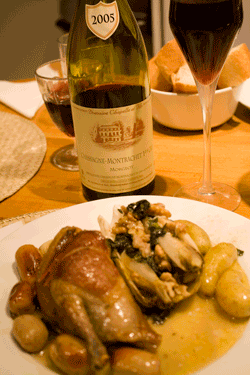
2005 Chassagne-Montrachet 1er Cru Morgeot Domaine Chappelle et Fils wine from the Borgogne. The vineyard is due south of the village of Chassagne-Montrachet, on the lower slopes of the Cote d'Or. Domaine Chapelle’s wines have a big reputation which is not always well deserved, in our experience. This one has a lovely cherry red colour, clear and bright. It is 100 per cent Pinot Noir, of course. It does not have a huge aroma and there is slight alcohol present alongside light berry fruit. The palate is well balanced and oak driven, without sweetness and quite long. Like all good Pinots it manages to fill the mouth elegantly. The tannins are firm and this wine still has a way to go – four or five years ageing would be spot on. There are better Pinots from the area. As a winemaker, I would have to say that if this is what you get from all the effort that goes into growing and producing Pinot Noir, why not plant Cabernet Sauvignon and achieve that fruit flavour more easily. However, Pinot Noir is a wonderful thing and it makes people behave irrationally. We paid €29 at the local independent cavista. The picture at left shows the wine plus our eat in meal for the evening - a beautiful pigeon purchased from the local Bucherie and prepared by the butcher with tender loving care. We made a stock with the head and neck and reduced this to make a sauce, adding a little cornflour and butter. We stuffed the squab with parsley and roasted it. We dressed it with little Boudin Blanc sausages, lovely new potatoes and endives stuffed with brie, basil, and walnuts. The meal cost us less than €20, barring the wine and we felt like royalty, especially with dessert of chocolate coated nougat and jam-filled pink macaroons. |
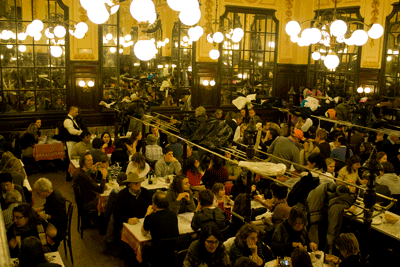
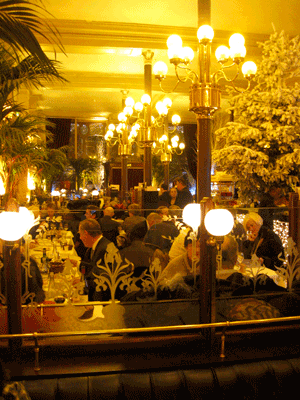
Bouillion Chartier The quality of produce, even in the dead of winter and, in some respects because of what is available in winter, is brilliant in Paris and makes an eat-in trip here a real option. If you have an apartment with cooking facilities then the markets and speciality food shops will dazzle you and get you some great meals very affordably. We have enjoyed the restaurants but see some worrying signs - chains are starting to predominate and, while this is not a bad thing if the quality is high, it tends to standardise what is available and drag everyone down to the lowest common denominator. This is Paris, so that is never going to happen completely and Paris's lowest common demonominators for food and wine are still relatively high. We ate at Cafe Benoit the other night and, while they clearly play for tourists, it was lovely. Restaurants like that and La Tour D'Argent, Le Grand Colbert, Maxim's etc. clearly aren't going anywhere, except into the hands of private investment groups. They are very expensive and not for people who are looking for value. However, the little independent Bistro is becoming an endangered species - a lot of them are not very good value and care more about getting lots of customers than preparing good food. Yet it is a big city in a little area and there are still many high value/high quality eateries, if you can find them. We stumbled on a brilliant place the other night and were thrilled by the quality and easy-going style and service. We got there very early (7.30pm) but, by the time we headed out the 400 seats or so were all taken and people were queuing around the corner on a wet and freezing night. It was, as I suspected, one of a chain, but one which does the French bistro very well both in style and quality and has been a leading restaurant in the city for two centuries. Bouillon Chartier, at 7 Rue du Faubourg Montmartre, in the Ninth Arrondisement, claims to have satisfied 50 billion bellies during that time (which seems one hell of a claim - one hates to think of the carbon emissions). It is one of nine owned by the same company but a dead giveaway for its value and quality is that 99 per cent of the clientele are Parisians. Denice had an avocado entree with prawns, followed by a beautifully cooked medium steak and prunes with ice cream for dessert. I had foi gras, followed by steak tartare and, for dessert, a huge lump of excellent cheese. We washed it down with a tasty Graves red. Nothing flash but it was probably the cheapest meal we have had in Paris and one of the best, not only for the food but the bustling atmosphere. Interestingly, although Denice and I are both highly challenged when it comes to speaking and understanding French, we have never had trouble in a restaurant. D has a little phrase book which has proved useful a number of times. The expression we like best is: "Je prendrai la meme chose qu'eux" - I'll have what they're having. |
 |
 |
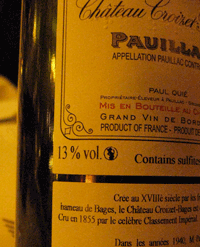 |
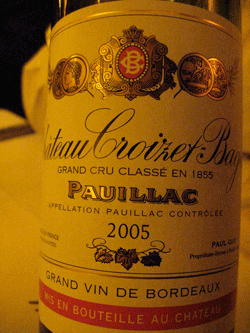
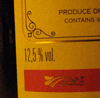
2005 Chateau Croizet-Bages, Paulliac The vineyard, between Paulliac and St Julian, in Bordeaux, from whence this wine came is classified as Grand Cru, fifth growth and within one of the most important appellations in France. Interestingly, it has been a struggler over the years by some accounts (compared to its illustrious neighbours, that is) and we found this in Le Grand Colbert, a restaurant in Sentier, near our apartment, associated with a theatre that gained fame in the Hollywood film “Something’s got to Give” starring Jack Nicholson and a wrinkly tart. Consequently we paid an outrageous price. From the composition of the vineyard, which produces only two wines, this one and a second stringer called La Tourelle de Croizet-Bages, it is a safe assumption that this is dominant Cabernet Sauvignon with Merlot and a bit of Cabernet Franc. That is consistent with the area and the Paulliac appellation. It tastes that way too. We loved the wine. We drank it with a rare roasted Chateaubriand of beef which was a perfect match and its strong and lovely perfumed nose made itself known immediately the bottle was opened. Our notes on it were cassis and vanillan oak on a very elegant nose, a well balanced palate with slightly restrained fruit and excellent tasty tannins and a long finish. It has a very positive presence – we could smell it without moving the glass from the table and, on the palate, the wine released flavour in a little explosion on the front palate which dissipated mid palate, leaving a satisfying tannic back palate that hung there for a long time. For all this, it is a medium-bodied and bone dry wine, yet there is enough structure to suggest that it will age well for at least another four or five years. I suspect controversy about this Chateau comes from the methods used to make the wine. The fruit is machine picked, for example, although a team goes through the vineyard prior to picking to cut out diseased and unripe berries. This is a method used widely in Australia and mimics hand picking, where any undesirable berries are cut out during the process. It sounds fair enough but you need to understand the extraordinary lengths to which some of Chateau Croizet-Barges’ neighbours go to get perfect fruit. Chateau Mouton Rothschild and the leading houses hand pick and then sort berries on a large table, either at the vineyard or at the winery. Another oddity I noticed is that the front and back labels had conflicting information about the alcohol content with one claiming 12.5% and the other 13%. Perhaps one was printed before chaptalisation, the other after. I love the French. They remind me of home. €75 (you should get it for half that elsewhere). Anyway, we thought the 2005 was a lovely wine and one which compared favourably with the best Cabernets and blends produced on our own Granite Belt. The more I drink wines from the north of Bordeaux, particularly between Medoc and St Estephe on the western bank of the Dordogne, the more I see similarities in what we produce around Stanthorpe. I would love to taste this wine alongside our own 2005 Upper House Cab Sav and I will see if I can find one or something similar in the duty free on the way home. The other big question I am asking is why don’t more of us produce Bordeaux-style blends? Part of the answer to that, I think, is that our customers do not understand blends and assume they are inferior. |
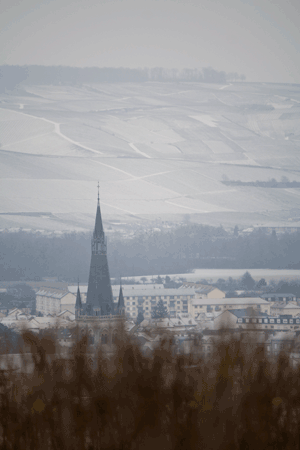
December 15 2010 We took a trip to Epernay that did not start auspiciously. We arrived at Paris Est station to find that our local train had been cancelled. We would have to get a TGV to Reims and a connection to Epernay which would deliver us there four minutes late for our first appointment. It was that kind of day but, as usual, we ended up having a wonderful and informative time. It pays to stay flexible. A note about France’s very fast rail system, the TGV. There is something regal about sliding through the scenery, in complete comfort, at the rate of five kilometres a minute. Other than the odd tornado, pretty much nothing in nature can maintain contact with the ground and travel at that speed. The TGV is one of the best things about France and should be compulsory throughout the world. On a TGV I feel an exhilarating smugness – king for a day, master of all that I pass (externally, at least). Unlike the German fast trains, TGVs don’t have digital read outs at the end of each carriage telling you how fast you are travelling. However, the trains run on overhead electric wires which are supported by steel arches around 40 metres apart. With the snowy landscape streaming by, we passed two of these arches every second. Eighty metres per second is 4,800 metres per minute; 288 kilometres per hour. Wow! When we got to Reims we expected a slow train connection to Epernay but found ourselves shuffled onto a coach by a very friendly SNCF (Société Nationale des Chemins de fer Français) employee who kept on about how warm it must be in Australia at this time of year. Quite. Epernay was snowy and inclement. We hired a car because we needed to visit some out of town champagne houses. However, with the snow getting worse we decided to stay local and send our apologies later.
|
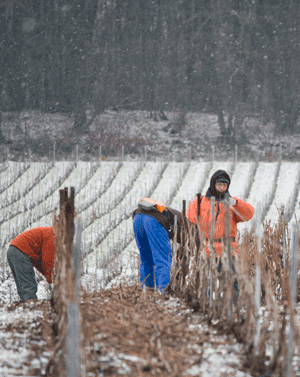
The town (apparently two villages that grew and joined) is in the Marne Valley and the slopes of the low hills beside the river are where Pinot Noir and Chardonnay grapes are grown. Pinot Noir, especially, has low resistance to disease so it is grown on the hillsides where the air circulation is better and the humidity is lower. Almost all of the vineyards you see along the river banks and on the flat are Pinot Meunier, which is a tough little baby. A highlight of the day was driving up into the hills above Epernay. It was bitterly cold and one can only imagine how the pruning teams were feeling as they moved, vine by vine, down the rows. We got some truly memorable photos but got back into our little Renault Clio thanking God for heaters and Australia. Another highlight was a visit to Moët and Chandon’s famous cellars. Epernay is home to several of the great champagne houses including Pol Roger, Veuve Clicquot and Perrier Jouët. Moet is the undisputed king, the biggest champagne producer in the world, and lesser houses must feel downcast when every visitor to town heads straight there. It was a fabulous and very professional presentation – as visiting winemakers we got no particular treatment but I was impressed that between our guide (called a house ambassador) Yumi Laforge and the chap who poured our tasting glasses, Marc, they answered all of my questions, including technical vineyard ones. The cellars below the imposing building are vast – 28 kilometres of tunnels storing the output of 1000 hectares of vines plus buy-ins and back vintage bottles of up to 10 years plus historical stocks. Moët and Chandon is very good at spin, as you may imagine. They make a great deal of Napoleon’s visit in 1807, who left them a wooden vat of Port wine he had recently nicked from Portugal for which it seems likely he received a lifetime’s supply of Moët and Chandon champagne from his “friend” Jean-Rémy Moët.
|

[A further note on Napoleon. It was he who “suggested” that some of the better vineyards in Bordeaux should be registered and classified. A suggestion from Napoleon was like receiving a rose from the Mafia. Thus, in 1855, was born the Bordeaux Wine Classification System, which I can never decide whether to love or hate. Other regions later adopted "cru" systems, designating villages or individual vineyards as grand cru, premier cru and lesser classifications depending on their "terroir", a subjective term combining historical perceptions about the interaction of particular soils and local climatic conditions. A formal appellation system was introduced throughout France in 1935 to protect the integrity of wine regions. More on this later; it is worth trying to demystify France's complicated system.] Moët and Chandon also talk up their tenuous connection to Dom Perignon, the blind monk who invented champagne. They own the vineyard plot which the Abbe Saint-Pierre d'Hautvillers monks worked and their premium champagne is eponymous. Every bottle of Dom Perignon is claimed to contain a small portion of grapes from this vineyard block. The rest of the grapes, Pinot Noir and Chardonnay with slightly more of the former used, are sourced exclusively from grand cru vineyards. Moët and Chandon pick and ferment all of their blocks separately then blend into bottles. For their regular non-vintage range, they typically include up to 40% of the two most recent vintages to ensure consistency and quality. It is a tough job for the winemaker – because the wine will undergo a second fermentation in the bottle and rest on its lees for at least two years before being riddled, disgorged, dosed and corked, and this is their one and only chance to get it right. That does not happen with still wine; there is always an opportunity to fix things at the end. With champagne you get to “dose” the disgorged bottle with sugared water (or sometimes grape juice or cognac) but otherwise you take a punt up to three years before finally sealing the bottle. Vintage champagnes are wonderful things and champagne ages beautifully. People spend a fortune on them even though it entirely unnecessary to do so. Certainly, a ten to 15 year old vintage champagne will reveal lovely subtleties but so will a non vintage one kept for the same time. It simply has no reference on the bottle, unless you write the purchase date on it yourself. The absence of the finishing date is just part of the spin that has made champagne such an enigma and one of the great marketing stories of the ages. |
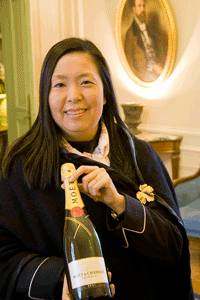
Moët and Chandon Brut Imperial We tasted this wine at the end of our tour. It is a lovely light straw and the bubbles are fine and quite restrained. The nose was floral - Marc said blossoms, sounds better – with distinctively fragrant yeast. Moët makes its own yeast, the others houses get theirs from the Pasteur Institute in Paris. Moët says it makes a difference and, now that it has been pointed out to me, I think they are right because it is a fragrance that I recall from other Moët and Chandon champagnes that I have had the pleasure to consume. All of their wines, with the exception of the Dom Perigon range, blend three grape varieties: Pinot Noir, Chardonnay and Pinot Muniere. The ratio changes year by year but Pinot Noir is always dominant and Pinot Muniere is always the smallest proportion (less than 30%). The palate is slightly nutty, with restrained, extremely well balanced citrus - lemons and gently exotic lime. It has a long finish. It is an outstanding wine. We purchased a bottle for €30. |
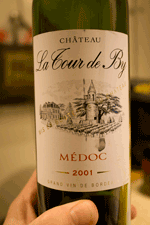
2001 Chateau La Tour de By A Cru Bourgeois Medoc wine (north and west of the city of Bordeaux and part of that broad region) and recommended to us by a young chap in an independent “Cavistes” bottle shop in Paris. The colour is a deep ruby claret, as it should be and the nose has restrained fruit and something – not unpleasant and certainly not dominant – that smells like an iron foundry. The appellation suggests that the wine would be chiefly Cabernet Sauvignon grapes. This is confirmed on the palate and – more importantly – on the label, which helpfully states: 60% Cabernet Sauvignon, 35% Merlot and 5% Petit Verdot. I think it must be the Petit Verdot which gives the wine this slight iron character or, perhaps, the use of older oak. The palate is fruity, slightly sweet and gives way to firm and pleasant cedery oak on the back palate. It is surprisingly delicate for a nine year old wine but another couple of years cellaring would not hurt it. Like most good Bordeaux it is medium-bodied but well structured. It is a good, if unspectacular wine and brilliant value, as the young Cavistes chap told us it would be. I checked the Wine Doctor’s review of this (LINK) and he also picked up on the iron. He bags the Chateau generally but he is, I think, mistaken about their plantings. I suspect the Petit Verdot they use may have been taken for Cabernet Franc, which may explain why some of the wines do not meet his expectations. €16. |
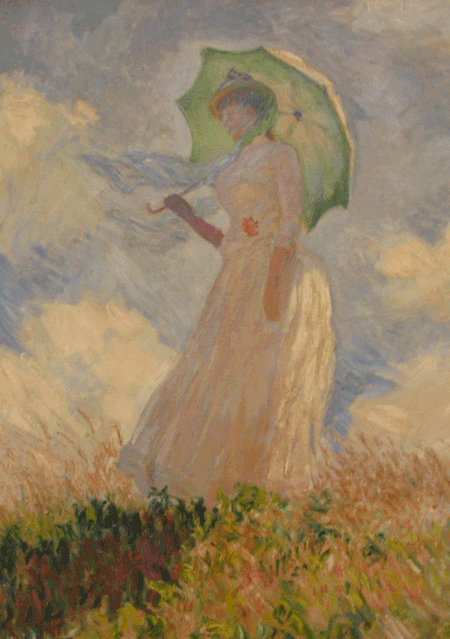
December 13 2010 The Monet Exhibition, currently running in Paris, must be the most monumental art production ever mounted, having been drawn from just about every major public gallery in the world and putting this lovely bloke's life's work into one stunning tableau. We first tried to get in a week ago, only to be told that all advance tickets were sold and we would have to wait outside in freezing cold for two hours. Even ticket holders were having to wait up to an hour. Let me put this into context: this is mainstream art; an exhibition, well into month number two of a three months run; every day people queue like this between 10am and 10pm to see paintings hanging on a wall. Somehow, I just cannot imagine this happening in Australia, even if we had an exhibition of such excellence. On our first attempt, an attendant suggested that Monday night at 7.30pm would possibly be our best chance of getting in. So here we were - we joined the queue at 7.50pm and got in at 8.25. The exhibition is on at the Grande Palais - an imposing building off the Champs Elysee which I have always wanted to visit. When we finally got inside I realised that it is basically just a fairly modern exhibition centre with none of the usual French elaborations evident. However, that was the only disappointment. To see Monet's work pieced together as it has never been before was stunning: the elegant pictures of his youth blossomed into the serial works of his maturity - hundreds of pictures sourced from almost every national gallery in Europe as well as all the important collections in the US, take you through his youth in Paris, his visits to the Normandy beaches, to landscapes around the Seine, his passing fascination with portraiture, his lasting one with still life, and, finally, to his wonderful garden in Giverny where he elaborated on poplars, haystacks and the water lillies under the Japanese bridge in the pond he designed, built and planted. To see different versions he painted of subjects like Charing Cross Bridge, the Saint-Lazare railway station, the Tuilierie Gardens, Etratat Beach in Normandy, sometimes at various times of day, in changed light conditions and sometimes across seasons, is to begin to understand his preoccupation with light, shape and colour. His work became increasingly minimalist while his outlook became more worldly. A great example of his "less is more" approach was the arrangement of three pictures of a woman with an umbrella on a windy day. The picture at left was taken on a previous visit to the Musee d'Orsay and is part of their permanent collection. This work was was joined by two similar paintings done at around the same time, one sourced from the New York Met, the other from a European gallery. I wish I could show the three lined up to demonstrate the progression of thought, light and feeling but "no photographs, please" was Stalin's order of the day. The collection comes to a crushing fullstop with the heartbreaking portrait of his wife's dressed corpse. |
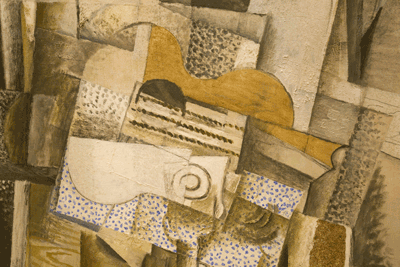
The exhibition was all the more poignant for us having, the day before, visited the Pompidou Centre and viewed their modern collection, which I had not realised was so good. It has probably the best collection of Picassos in existence with excellent Braque, Matisse and Dali, along with other leading cubists and surrealists and not just paintings - lots of sculpture, spaces and design. People remain free to take pictures here so we did. I will put a gallery of my favourites together on our Facebook site, for anyone interested. CLICK HERE The Pompidou Centre is huge and, throughout the year, they stage several exhibitions in addition to the permanent works. The expressionist Arman (Armand Pierre Fernandez) is currently featured. Arman's creativity was astonishing and the magic he could weave with simple raw materials (such as blowing up a sports car) was awe inspiring. "No Photos" was here too so look him up on the web, you will be glad you did. Try the Pompidou Centre site and search for Arman CLICK HERE. At left is an image from the Pompidou's modern collection by Georges Braque - Man with guitar. That would be my friend Lee Williams, presumably. Yes, there is passing resemblance. |
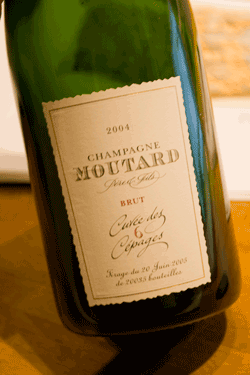
As always, I began writing today with the intention of reviewing a wine - there are so many distractions in Paris. Champagne is why we came here, so champagne it is. Fine champagne is the classic refreshment, suitable for all occasions - well, almost. It should not be served at funerals. It produces an immediate lift in spirits and creates a private party in the mouth. When swallowed, it leaves the impression that whatever calumnies may visit, things right now are not all that bad. Which raises the question of whether champagne has ever been tested as an anti-depressant? Two reputable websites, adrenalin.com and coffeeworks.blog.com, cite champagne as a “proven” anti-depressant. Despite this compelling evidence, I could find no formal research and conclude that (a) it would be difficult to secure research funding; and (b) whatever the results, the cost of the treatment would ultimately depress anyone who tried to apply it. 2004 Champagne Moutard Pere & Fils Brut Cuvee Six Cepages This is the wine which sparked the above revelation. It is an excellent champagne - fresh, despite its years and slightly, pleasingly sweet and it creates instant happiness. It is the first vintage champagne I have reviewed on this trip. It is fom the far south of the Champagne region, in the Aube Valley. Moutard Pere & Fils are famous for this wine because it contains all six of the allowable grape varieties (cepages) of the appellation. Yes, six: Arbanne, Petit Meslier, Pinot Blanc, Chardonnay, Pinot Noir and Pinot Munier. In practice, three of these – Arbanne, Petit Meslier and Pinot Blanc – are rarely used and scarcely heard of in the region these days, although Moutard also produces a straight Arbanne which is reportedly creamy with honey flavours. The six cepages is well balanced, pleasingly sweet and luscious. The colour is pale straw, despite its six years. The bead is fine and the wine not overly effervescent. There are citrus and apple aromas on the nose with yeast lingering below. The palate has three parts: soft pear flavours on the front, orange and firm acid in the middle and the finish is lemony, long, soft and creamy. I could not discern individual varieties in it although, it had perhaps less of a Pinot Noir character than many mainstream champagnes - no strwaberries or raspberry flavours or hues. I can imagine Chardonnay and Pinot Munier, the letter especially in the mid-palate, but there were no big surprises, either good or bad. An excellent wine and one of the best champagnes we have tasted. We paid €27 to a very knowlegeable off licensee in the Mouffetard market. |
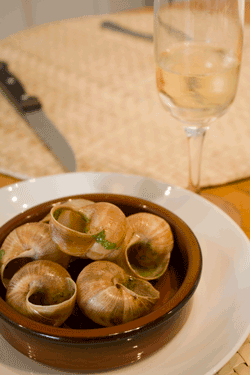
The Moutard Champagne made a perfect match with escargot (snails), purchased from another highly knowledgeable craftsman in a local bucherie. They were prepared, in their shells, with parsley, garlic and butter. He advised me to place them upright, so that they do not spill, in a suitable ceramic container and heat them in a low oven for five minutes or so "until they - how do you say - booble". Well, yes. This I did and, as the last molluscular breath spun fine bubbles through the melted medium, I removed them, smelt them, eyed them, savoured them and, mostly gladly, consumed them. Prepared this way they are deliciously tender, giving fleeting resistance to the teeth, followed by a rush of mild, earthy meat flavour which mingles, in roughly equal part, with the butter, parsley and garlic. So good were they that they were gone before I remembered to take a snap shot. Thus, you see empty shells and the remains of a glass of bubbly. Sigh. Snails, now departed, otherwise known as escar-gone. Texture is the key. Many of France's famed foods have special textures – the bubble popping feel of shaved truffles, the silky smoothness of foi gras, the soft gooiness of haricot beans, the creaminess of camembert cheese, the light, chewiness of nougat which dissolves in the mouth. We had a Boudin Blanc sausage after the snails - bloodless pork meat incuding the drained heart and liver, minced very finely. Gently poached and then coloured in the pan, it almost floats away it is so light. Texture is important in France. So there we are back with Monet and Armand. Damn. Only a week to go. Sigh!
|
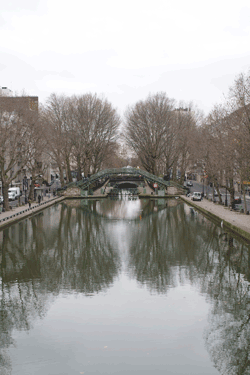
December 11, 2010 Saturday, when, after about 11am, all of Paris comes out to play until very late. We had an extraordinary day ending up finding almost everything we did not seek and vice versa. We are travelling to Epernay on Wednesday with appointments to see Moet and Chandon, Messieurs Meteyer etc so we wandered up to Gare De l'Est to book train tickets, then, via the St Martin Canal, to a flea market near Rue De Bretagne that Denice wanted to visit which turned out not to be there. Wrong day or something. However, we found the Marche des Enfants Rouges, a food market in the same street that had wonderful everything. We settled on whole freshwater trout and purchased leeks etc to go with it. We also found a small wine stall which had a couple of Vouvrey wines. Vouvrey had caught my notice at Frenchie Restaurant the other day, the more anal among you will recall. Too good to miss - dinner was going to be trout with Chenin Blanc, the perfect match. We were ready to head off but it was time for lunch so we popped into a cafe attached to the market called L'Estaminet (The Tavern) and had the plat du jour - potato gratinee with beef, wonderful - and 50 centiltre pitcher of Domaine Antugnac Cote D'oc from the Roussillon area where they tend not to worry too much about appelations. We were assured it was a Merlot/Cabernet Sauvignon and it may well have been. Great place. Lovely people, lovely food and good fun. |
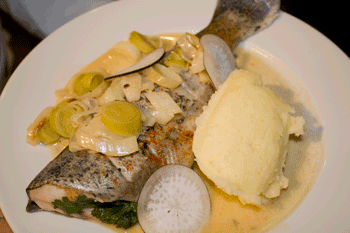
For the foodies among you: the fishmonger courteously cleaned our two fish and reserved the heads for us to use in a stock. We simmered the heads in water with carrot, hard leek leaves, celery, garlic, onion, cardamoms, salt and pepper. We rinsed the trout, salted the insides and stuffed them with garlic and parsley then scored each side with a knife and put them in a pan with olive oil, sliced leeks, garlic, a sprinkle of paprika, sea salt, white pepper and a slurp of rose wine from Provence, which we happened to have handy. The fish was poached until tender - about ten minutes - then rested while the juices and pan vegetables were added to the stock and reduced with a tablespoon of fresh cream. We served it with potato mash and slivered black radish. It was - yeah, okay. By the way, this whole meal (not counting wine) cost less than €10. |
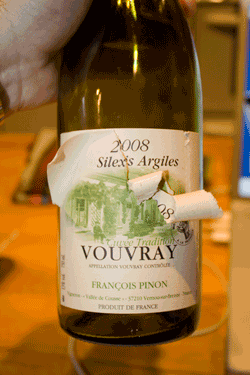
2008 Silex Noir Francois Pinon Vouvray Cuvee Tradition Now here's a tale. Recall, we got this wine from a market stall. A little research showed me that Francois Pinon runs about 14 hectares of vines in the Vouvray area near Tour, in the Loire region, as did his father before him and a further five generations preceeding. Vouvrey is famed for its Chenin Blancs which range from dry to very sweet wines and include excellent sparkling wines. Since 2007, Francois has split his Couvee Tradition wines into Silex Noir (those grown on flint soils) and Les Trois Argiles (three clays). The one I purchased had a label on it that said 2008 Silex Noir. It was only later that I noticed that this label had been applied over another. I peeled the first away to reveal 2008 Les Trois Argiles. So, we either drank one of them, a blend of them or none of them. You see, it is not only small Granite Belt wineries which run their business so flexibly. I have always maintained that our approach is very French. Anyway, whatever was in the bottle was a pretty punchy wine for a Chenin Blanc - absolutely nothing like any Chenin Blanc I have tasted in Australia and I can see why Frenchie's Gregory Marchand likes the area because this wine is absolutely sweet and sour. It is a demi sec wine with a nose of citrus rind and apples. The palate is bold with citrus, quince and a distinct sweetness balanced by very firm acid. I suspect this is not the best of its type and I look forward to finding one that is. However, it is food for thought - a really interesting wine. We paid €11 for the wine, merci beaucoup. Don't you just love those days when things don't go according to plan? We even found a dry Sauternes but that is a review for another day. |
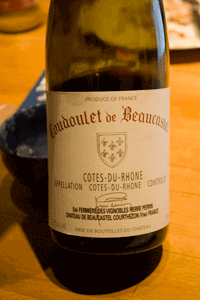
2001 Coudoulet de Beaucastel Second string wine of a big company which produces fine wines from the Chateauneuf Du Pape appellation in the Rhone, about 30 kilometres north of Avignon. The company’s web site reports that this wine comes from the northern most limit of the appellation and the usual composition of the Coudoulet De Beaucastle is Grenache 30%, Mouvedre 30%, Shiraz 20% and Cinsault 20%. However, the 2001 vintage label notably does not mention Cinsault, suggesting dominant Mouvedre over Grenache and Shiraz. Age certainly has not wearied the wine. Chateauneuf Du Pape reds are among my favourites and the juicy, savoury character of this wine sums up why. It is a complete mouthful – something that cannot be said of lots of really good French wines, whose elegance sometimes pulls them back from instant gratification – how do I put that in a way that men will understand? Okay, picture the latter as a long, well considered relationship and the former as a quick but satisfying shag behind the shed. This is a wine which would attract Australian males who like “a big red” (ladies, henceforth you may recall the shed when your hear the expression). The wine is full and mouth-filling. Almost certainly it has not been chaptalised (sugar added to the fermentation) as fruit flavours dominate. Black fruit and spice on the nose with a bit of chocolate that are joined by leather and tobacco on the palate – so much of the latter, in fact, that, as a reformed smoker, I find myself longing for a lingering Petit Punch (yes, I keep leading with my chin). The company’s website suggests that leather and tobacco flavours are features of the Mourvedre grape. Alpha Aussie males should not look for a jammy Mudgee Shiraz in this wine. It is much more complex with lovely Vanillan oak balancing the sweetness of the mature fruit that made it. €17.60. Great value and makes me want to try the number one wine from their Chateauneuf Du Pape vineyard. Read more about them HERE |
 |
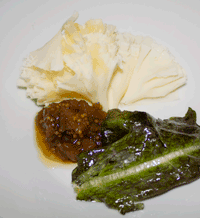 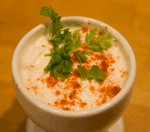 |
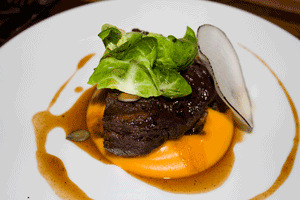
December 8 2010 Denice and I both have colds but they are getting better and we decided to keep our reservation at Frenchie, nearby in Rue Du Nil. It is a tiny restaurant and ever since it was recommended in the Michelin guide it has been hard to get a table apparently and especially so since it was reviewed in the New York Times in April this year. It is run by Gregory Marchand who is clearly obsessed with good food and quite happy to be running a small restaurant extremely well. We wanted to go to dinner but, on enquiring a fortnight ago, were told we would have to wait until January. However, we managed to book for lunch. Our taste buds weren't working all that well but it was a wonderful experience anyway - the menu has a choice of two entrees, mains and desserts, all prepared freshly in the morning by Gregory, working alone. Denice had the speck salad with clementines (little orange-like fruits) and I had a chicken liver mousse. We both had beef - a slow cooked Brisket or Chuck steak with brussel sprout leaves and tiny turnips, possibly pickled, on a puree of pumpkin (pictured). The other choice was was gnocci with mushrooms and pickled red onion. The NYT review mentions that Gregory favours sweet/sour combos. Desserts were a superb cheese (the name escapes me) carefully shaved and arranged like a flower on the plate (pictured) or, alternatively, a chocolate mousse with burnt caramel. Everything was excellent and great value for €28 a head. Gregory, a Parisian, first surfaced in London working with Jamie Oliver at his 15 restaurant then at New York's Gramercy Tavern. Anyway he is back home and, to us, he personifies the care and respect with which the French approach food. The menu changes every day so don't expect to replicate our experience. Note the white disc vegetable in the beef dish. It is a black radish, which I haven't ever seen in Australia and the vegetable caught my eye in a local shop the other day. It has a flavour somewhere between red radish and horse radish. Coincidentally, this morning I was mucking around, trying to figure out what to do with it. I peeled and grated it, added a little fresh cream, a tad of Dijon mustard, good salt and topped it with chervil and paprika (pictured bottom right). Not bad, I thought. Anyway, Gregory apparently doesn't see the need to go to this trouble. Never mind, after a big lunch we only need a light supper so we'll have this with a little left over meat loaf. |
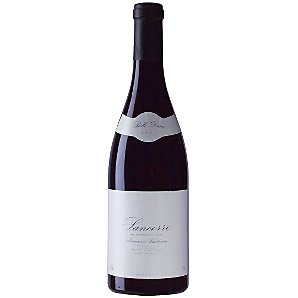
I had to nick this image from the web. The wine waiter decanted the wine and whipped the bottle away before I had time to take a snap.
2006 Domaine Vacheron Sancerre Rouge Belle Dame Gregory has a wonderful and highly personalised wine list. It contains, for example, the Drappier Brut Nature champagne made with 100% Pinot Noir which I reviewed earlier in the trip. I scarcely recognised any of the other wines on the list, however, and decided to trust Chef's tastes by choosing the most inscrutable one there - a red wine from Sancerre, in the Loire Valley. The area is famed for its white wines, made mainly from Sauvignon grapes. I had no idea that reds were made there. The 2006 Vacheron Sancerre Rouge Belle Dame is an amazing wine - powerful and spicy so that, at first, by the nose, I thought it was a Shiraz. Then on the palate it threw me. Pinot Noir came to mind but it seemed too full and powerful. It was indeed a Pinot. Amazing. Chris Kassack's wine doctor website reviews it - he was also clearly stunned by it. My palate wasn't great today so I will rely on Chris's review: "This cuvée is sourced from a silex (flint) terroir in Les Romains. There is certainly a greater depth here; there is still some oak showing, but it also has smoothly polished beetroot and fresh berry fruit. A good texture and substance, savoury grip and lovely, light-cream weight. Piles of structure underneath it all. Overall a fine character." I agree with all that - a wonderfully complex wine and worth the €65 we paid for it since we probably will never get the chance to drink it again. The restaurant's wines range from good house wines for €6 a glass up to rare old bottles for over €100. The cheapest bottles start at €24 but they are all personally selected and probably excellent value. He favours Pinots. Apparently Domaine Vacheron is a small family business and while they have over 40 hectares of grapes, mostly within the Sancerre appelation, just two hectares are planted to Pinot Noir at Les Romans from whence came this wine. For those of you with acute insomnia, here's a link to the wine doctor's notes on the Sancerre Rouge: http://www.thewinedoctor.com/loire/vacheron.shtml I had a glass of white with my entree. It was from Vouvray which I learn is in the Loire and generally consists of Chenin Blanc, though sometimes they also use a little Arbois. It was very pleasant and I shall seek out some more. |

NV Champagne Meteyer Pere & Fils Brut Exclusif This wine is 100% Pinot Meunier and made by Earl Meteyer & Fils of Trelou sur Marne. I have been looking forward to this review for days. I had never seen or heard of a 100% Pinot Meunier before, now I am drinking one. Initial observations are of a light straw wine with a tinge of pink on the meniscus. There are mushrooms on the nose and a trace of lemon rind. The palate is acidic, dry, even bitter, a la Angostura Bitters, but with a haunting sweetness also from the fruit which is why, perhaps, the winemaker describes a fruity wine. He also suggests pears, peaches and honey on the palate. I taste pears but mostly I detect elegance and a submerged conflict between sweet and sour. I can see the resemblance to Riesling that prompts some to refer to Muniere as Black Riesling. We drank half a bottle at lunch and left the rest for dinner – letting champagne settle for a few hours produces a less vigorous wine and the flavours are easier to appreciate. It became obvious that this wine had a lovely creamy finish, probably due to malolactic fermentation and resting on lees for a couple of years. I enjoyed this wine for what it is and particularly appreciated the opportunity to taste a 100% Pinot Meunier. Compared to “benchmark” champagnes which blend Pinot Noir, Pinot Meunier and Chardonnay, this one lacks a little on the front palate but has great acidity, elegance and a good finish. A few days ago we tried a 100% Pinot Noir Champagne (Andree et Michel Drappier Zero Dosage) and described a wine which had a full front palate with rose fragrances and strawberry flavours but lacked a little on the back palate. Having tried this Meteyer wine it is easier to see how Meunier fills out the back palate and adds acid. We ourselves make a blanc de blanc (100% chardonnay) so we are familiar with the underlying power and length that chardonnay contributes. Put them all together and what do you get? Well, I think it proves the point that what you should get is a superior wine combining flavour, power and elegance. Slowly, we learn. The Meteyers have a family business and the small vineyard has been extant for generations at a wee town between Reims and Epernay and a little west of both. Their website tells the story well so I shall not repeat it. We are hoping to arrange a meeting. I’ll keep you posted. Meantime, please enjoy their website: www.champagnemeteyer.com. |
December 5 2010 Sunday gave us a chance to visit the Musee Marmottan Monet in La Muette, out near the Seine, in the west of Paris. Denice and I love Monet and wanted to go to the Monet Exhibition being staged at the Grand Palais but, when we arrived, there was a two hour wait. It was suggested that if we came back on a Monday evening, we may not have to wait so long. We plan to do that but in the meantime we went to another brilliant Monet exhibition at the Monet Museum. |
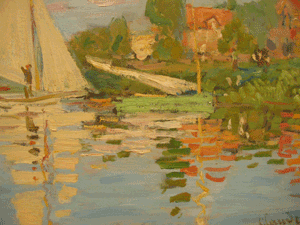
Monet was very, very... very good with water - a few offhand brushstrokes say everything. The pic at left was taken a few years ago at the Musee D'Orsay. One real disappointment on this trip is that all of the public museums in Paris have now stopped people taking photos of exhibits. Their signs suggest that flash photography damages the exhibits but they have used this as an excuse to ban all photography. I suspect the real reason is to boost gift shop sales and prevent people using images, now out of copyright, to make their own profitable merchandise. Anyway, it has diminished the experience for me; I used to take detailed shots of exhibits that I liked so that I could study them later, working out how and, possibly, why the artists did what they did. Il ne plus pas possible, damn their eyes. Anyway, it was a great long weekend with visits to the Orsay, the Musee du Vin and the Monet. This last had working drawings as well as multiple versions of his famous lilly pictures, demonstrating how he developed them. Brilliant. |
 |
 |
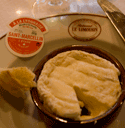 |
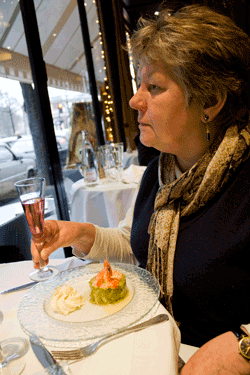
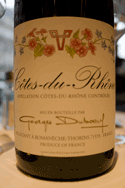
The wine connection came afterwards when we visited Bistro De La Muette for lunch on the way back to the metro. It is mentioned in the Michelin Guide (and several others) and is a modern but traditional Paris bistro offering a limited menu of exceptional quality. They are actually a small chain (a disturbing trend in Paris) of seven restaurants. This one simply offered a three course meal from a well balanced menu plus an aperitif cocktail and a bottle of wine from a selected list for €39 a head. We hadn't planned on having an extensive lunch but one look at the menu persuaded us to abandon dinner and take a long, late break. This was a great decision and the meal was exceptional value. To start, Denice had an avocado timbale (which they called a "bio") with prawns and a passionfruit mousse. We will recreate this dish - the mousse was spectacular. I had duck foi gras and fig chutney - again, exceptional quality. Main courses were, for Denice, lamb and rich gratineed potato with an excellent jus; mine was a honey-glazed roast breast of duck with a tasty sweet jus and fetuccini pasta. 2008 Georges Duboeuf AOC The aperitif was champagne and creme de cassis in a tall flute - yum. We chose a Cotes du Rhone wine - a 2008 Georges Duboeuf AOC, which turned out to be mainly Shiraz. Georges is a negotiant and contracts grapes from many regions to make and market wines. This was lovely and, although the label contained precious little information, I assumed it was a Shiraz, Grenache Mouvedre blend. It tasted a lot like a Granite Belt Shiraz with lovely solid berry flavours, plums and, vaguely, olives. The wine was medium-bodied and soft with well balanced and tasty tannins. Can't give the price because it was part of the package. For dessert Denice chose crepes with flamed Grand Marnier. I could not resist the Saint-Marcellin cheese which was in great condition and truly heavenly. If you have not yet tasted this cheese then, should you get the opportunity, don't miss it. It is made with cow's milk, is soft, creamy and quite runny, which is why it is often packaged in a small teracotta pot. It has a nutty, mushroom flavour and is pleasantly salty. The cheese picture at left was taken at la Limousin Restaurant, Versailles. Bistro De La Muette's menu can be found HERE |
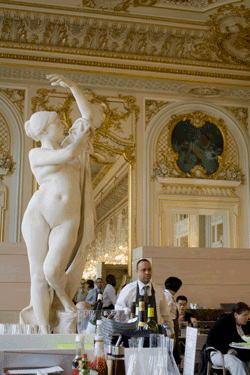
2002 Chateau La Garde While I am banging on about museums, I should add what a disappointment the Orsay Museum was this time around. They are renovating and only two out of five floors are currently open. Their famed Impressionist collection has allegedly been moved to the ground floor but it is a pale shadow of what it could be and usually is. There are few works on display and only one van Gough that I could see. Renoir gets a good guernsey but his best works are elsewhere - possibly in the tour that came to Canberra and is now in either New York or Tokyo. The Orsay arranged the Grand Palais Monet exhibition so they can be forgiven for the lack of Monets, perhaps, but with about four Lautrecs, a few Cezannes and a handful of Manets what is there on the ground floor certainly doesn't make the powerful impact that the full fifth floor exhibition used to give. Fortunately, the second floor restaurant is still open, though the surroundings are better than the food and wine. We had a very pleasant Graves (Bordeaux) wine: 2002 Chateau La Garde. It was full and fruity with dominant Cabernet Sauvignon over Merlot, although there was mulberry on the palate. It was deliciously soft. However, it was overpriced at €43. The surroundings make this one of Paris's great restaurant experiences. |
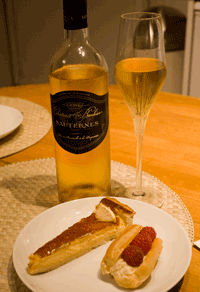
2004 Chateau Barbier Sauternes I found technical notes on the Jean Medeville Et Fils website which say just about everything that needs to be said about this wine and in a rather charming way: Château Barbier is part of the estate of Château Boyrein and is in the Sauternes terroir and appellation. The estate carries on the name of a commune called Fargues. The wine produced was already considered as the best 'Crû Bourgeois” of the region. Area : 17 acre(s) Vinification : After pressing and must settling , the grapes by small quantities are fermentated with a temperature control. The grape selections are grown in tanks before being blended. Notes: Nice gold colour with amber reflects. Elegant and complex nose offering aromas of quince, acacia and pineapple .A gourmet mouth and a delicate flavour of apricot and honey. the final is slightly toasted with notes of hazelnut. Suggestions : Delicious at the aperitif, this is the wine of all parties. A classical with foie gras and white meats, this wine becomes extravagant with asparagus and strawberries! There ya go. It is a good but unspectacular Sauternes in my view. Apricots and honey and, yes, perhaps pineapple. The weblink is: http://www.medeville.com/index.php?page=content&info=chateau&more=1&local=fr We paid €19.95 at a wine store near Opera. PS. Goes really, really well with hazelnut nougat but doesn't everything? |
December 4 2010 Time to start writing this blog with the newest contributions at the top as is the method moderne. We have been in Paris for a couple of of weeks, with a short trip to London, and are now well into the wine side of the trip. I have been writing tasting notes. We came here principally to taste champagne but we have been side-tracked by lots of other things on the way. |
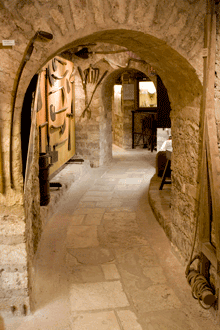
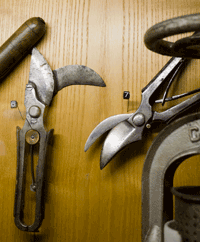
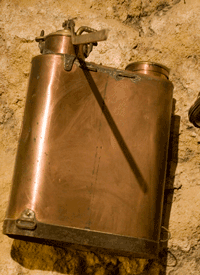
Today, thanks to Denice's tenacious work, we found the Musee du Vin, in Rue des Eaux, Passy, not far from the Trocadero. It is built in an old limestone mine and is entirely underground in the side of a hill in the sixteenth arrondisement. The mine existed between the 13th and 18th centuries and produced some of France's famed cobble stones. It hosted a well which was known for its laxative properties - a quality which French people, attuned to their inner machinations, naturally respect. In the 17th and 18th centuries part of the mine, which now house the restaurant and cellars, became the wine cellar of the Minimes Monastery. The nearby monastery had a vineyard, one of several in Paris at the time. It was renovated in the 1950s and was, for a few years, the wine cellar of the Eiffel Tower's restaurant. It then became a museum and, in 1984, was taken over by the Conseil des Eschansons de France, a group apparently dedicated to eating and drinking and, one may perhaps infer from the name, a little singing afterwards; somewhat similar to the Brisbane Beefsteak & Burgundy Chapter. The museum is a beautiful private collection of antiquities that traces the viticultural and oenological history of France - equipment used in the vineyard, cooperage and winery plus glass containers, both bottles and decanters. They did it tough in the early days. Interestingly the secateurs they were using 200 years ago closely resemble those we use now, as do the back pack sprayers - theirs copper, ours light plastic - and the laboratory glassware. But, oh, for a tractor. It was a great experience. The Conseil makes its own wines in the Gaillac region, south of Bordeaux and sells them at the museum. |
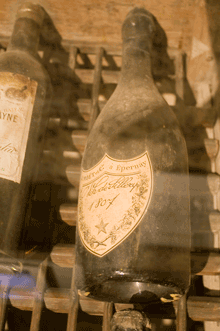
3 wines of Chateau Labastidie The Museum produces several wines which one may taste at modest expense. The Galliac region produces whites alternatively based on Sauvignon and Loir de Loeil varieties and Muscadelle and Loir de Loeil. The former is very similar to our (WGW's) Leapin' Liz - passionfruit and tropical fruit dominant, but also melons. The blend is 40% Sauvignon, 60% Loir de Loeil. It has a clean finish and is a good wine to drink young. The Rose they produce is made with Duras grapes which, without consulting Janisis Robinson, I don't think have any relation to Durif grapes. The wine had strawberry and currant flavours and also, we thought, a little mint. Pleasant and much drier than its Provence cousins, also a little darker, suggesting a few more hours on skins prior to pressing. The red is complex - merlot 35%, Braucol 30%, Syrah (Shiraz) 25%, Cabernet Sauvignon 5% and Cabertnet Franc 5%. The wine we tasted was a 2008 and could go at least another five years before reaching drinking age. Mulberries and spice, also a little licorice. The tannins were very firm. Good stuff but very young at present. By the way, the champagne pictured is an intact bottle of 1807 Moet & Co. Vin Du Sillery champagne, a marque wine of the period. The museum has also some late 18th century wines. |
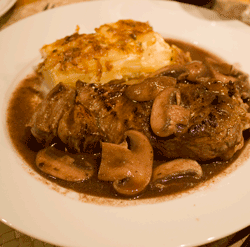
Note: On December 6 we tried a bottle of the 2008 Chateau labastidie red with a home cooked meal (entrecote steak with Swiss Brown mushroom sauce and potato and onion gratinee) and found it to be very good but perhaps lacking elegance. It is a medium-bodied wine and will improve with age. It certainly sits in a class of its own, set apart from the predictable behaviours of Bordeaux and other well known French red styles. The quality of the steak in Paris is very high by the way - lovely grass fed beasts which cook to perfection with huge flavour. A 650 gram entrecote, cut from the rib and almost (because they cut it slightly differently) what we would call rib fillet, cost €17. It was an inch thick and we used two thirds of it to make this big meal for two. I sauteed Swiss Brown mushrooms in butter and added beef jus that I had made previously from a poaching stock plus some of the red wine to make the sauce. Life is good. |
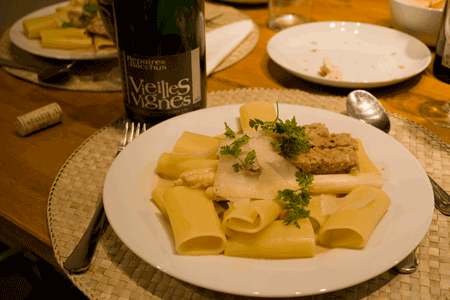
NV Repaire De Le Bacchus Cuvee Veilles Vignes A so called "second tier" champagne made by one of the new kids on the block, C. Rocassel, who has been around since 1983. Marketing is his strong point; the wine leaves a lot to be desired. Lots of bubbles - too many, although the bead is fine-ish. Strong lime fruit on the palate but not well balanced against the yeast and the finish. I was informed that the wine contained all of the classic champagne varieties - Pinot Noir, Pinot Muniere and Chardonnay. They appear to own no vineyards and this wine was apparently made on contract as negotiants. fair enough. Doesn't do much for me. €18. Of far more interest was the meal Denice prepared to go with it - superb Paccheri semolina and duro wheat pasta with white asparagus poached in champagne and cream topped with a pork meat loaf, Parmesan cheese and chervil. Heaven on a plate. |
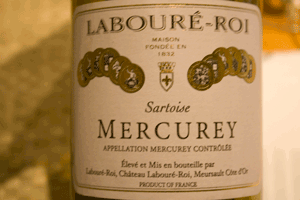
2009 Laboure-Roi Sartoise Mercurey A little Pinot Noir picked up from the local supermarket. From Mercurey, near Chalon-sur Saone and south of Nuit Saints Georges in the Borgogne. Flabby but cheerful. All the usuals but in no epic proportions. The label has lots of things that look like gold medals but definitely are not. €10.80. |
November 26 2010 On arrival in Paris the weather was wintery and not all that conducive to champagne, so we also gave Bordeaux and Burgundy a bit of time, along with various Loire, Rhone and other regional wines. So, to start, here are a few of the notes I made. Thanks to our daughter, Emily, who agreed to look after the vineyard for a few weeks, Denice and I were able to take an extended working holiday. We headed to Paris where, on the wine side of the business, we intended to concentrate on champagnes, since we released the first of our sparkling wines in December 2009. We made these in the time honoured French tradition using bottle fermentation. Whilst the wine is good and has done well at shows, it confirmed my suspicion that neither of us knew enough about bubbly. |
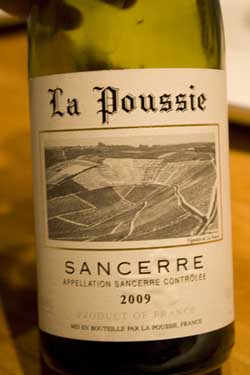
2009 La Poussie Sancerre One of Baron Patrick la Doucette's wines. Sauvignon Blanc. Beautiful depth of flavour. Loire Valley, one of the Pouilly Fume vineyards in a revered natural amphitheatre - though why it should be revered isn't immediately clear, since the amphitheatre seems to have a fairly severe erosion problem to this Australian eye. Being inured to NZ and Aus Sav Blancs this one was not immediately identifiable. It smelt like a fruity chardonnay at first. It is quite a big wine, grassy, but not hugely. Crisp and clean. Well developed. Dominant flavours: pawpaw, honey. Much longer palate than most Sav Blancs. Lovely wine. The brand is among the finest of the Loire whites. LINK TO FURTHER INFO ABOUT THE LA DOUCETTE WINES €18. |
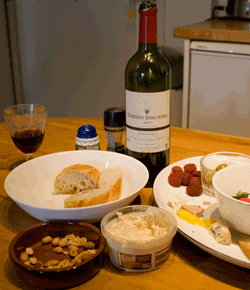
2007 Chateau Soulieres Bordeaux wine. From Gironde, just east of the city of Bordeaux and across the Gironde River from the Medoc. Passable Cabernet Merlot or Merlot Cabernet, I suspect. Not huge fruit but pleasant. Good value. €9 |
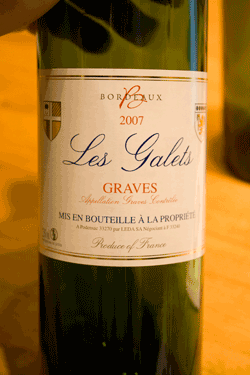
2007 Les Galets, Graves Cheap and cheerful. Graves is just south and west of the city of Bordeaux and adjacent to the Haut Medoc. Predominantly Merlot and Cabernet Sauvignon although Cabernet Franc is also grown. The area is known mainly for whites – Semillon, Sauvignon Blanc and Muscadelle. This red was unremarkable. It had that slight plastic flavour of the lesser Bordeaux wines. €12
|
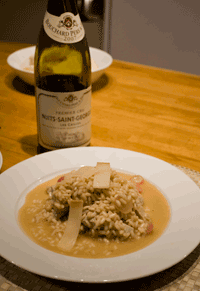
2007 Nuits Saint Georges Les Cailles Pinot Noir, Premier Cru. Bourgogne Region. A Bouchard Pere & Fils (Father and sons) wine Cote D'Or. A Domaine Wine. The company has vines at Nuits St Georges and Beaune and labels include Chassagne-Montrachet, Meursault, Puligny-Montrachet and Savigny Les Beaune. My notes: Fresh strawberry nose with strawberries and raspberries on a nutty, fruit-driven palate. Lovely balancing tannins with a slight tobacco flavour and great length and depth of palate. Not at all sweet. Brilliant wine. After writing this I looked up other reviews and found one that said licorice. Yes, a little, I think. N.B. Doesn’t go with chocolate. €45 We drank this with a risotto of milk veal and radishes. Wonderful.
|
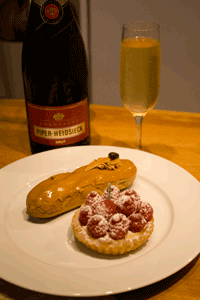
NV Piper-Heidsieck Signature Cuvee Brut Predominantly Pinot Noir, hand picked Pinot Meunier and Chardonnay. Blend is predominantly the current vintage plus selected previous vintages to maintain consistency. Aged a minimum of 24 months on lees. My notes: Efficiently good. Yeast and citrus on the nose, a dry and rather clinically precise palate of lemons, limes and melons. The chardonnay is evident on the front palate and a delicious sweetness on the back palate. The middle is firmly dry. Very good but no surprises. Goes with chocolate. €36 The coffee eclair and raspberry tart came from a local patisserie.
|
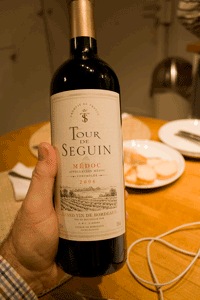
2006 Tour de Seguin A Médoc wine recommended by a beautiful girl in the foie gras shop. It says on the back (yes, a breath of fresh air!) that it consists of 57 % Cabernet sauvignon, 7% Cabernet Franc and 36% Merlot. One of the also rans but a very nice one from Chateau Seguin at Lignan de Bordeaux just east of the city, owned by Carl Wine. Cellar notes say “deep and very nice ruby colour. Powerful nose with aromas of black fruits and toasted notes.” – this last being apparently a mistranslation but generally meaning toasty tannins. My notes: Dark ruby claret with a traditional cassis aroma and a little cedar. Oak driven but well balanced. A medium-bodied, very dry wine with slightly spiky tannins. Pleasant and much better once it had breathed. It has enough fruit to cellar well for a few years. Doesn’t go with chocolate. €11.50
|
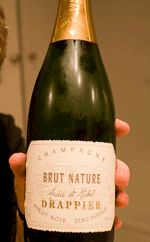
NV Andre et Michel Drappier Champagne Brut Nature Zero dosage champagne, touted by some as the way to go with champagne. From Urville, Reims. Andre and Michel are adamant that any champagne that needs to be dosed with sugar hasn’t been made properly and that the dose is there only to cover faults. Hmmm. Not a bad way to start our Champagne adventure on this trip to France. The Drappier champagne is pure Pinot Noir and it has a typical pink hue to testify to that. It is lovely and true to the bottle’s “Brut Nature” description. The predominant fragrance is yeast and the palate is full with lovely rose and strawberry flavours. This is a beautiful wine and wonderfully balanced. We are here to learn, not to judge but, interestingly, both Denice and I yearned for just a little sugar in this passionately no dosage wine. For an Australian, a steal at €28. Note: champagne is not horribly expensive in France.
|
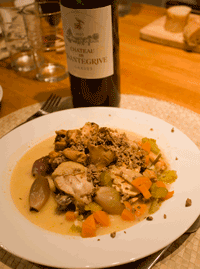
2005 Chateau De Chantegrive From Graves and recommended by our local vintner. We got strict instructions to decant the wine and leave it two hours before drinking. Indeed, the back label urges this. I opened the wine and decanted it, leaving just a little so that the lees did not contaminate the decanted wine. There was one very small lee that I could see so, I reasoned that, in the absence of any cloudy residue, the proprietors must have been concerned that the wine would taste raw and, therefore, recommended that it be left to settle. I poured the remaining drop and tasted it – lee included. Perfect. Not even a little bit raw; smooth as silk, a lovely Bordeaux. So, in labels we trust? Non Monsieur. Nevertheless, as a good little wine student I did as the label instructed and left it for two hours. It tasted a little fuller than previously but by a miniscule amount. Now, having bagged the label, I love this wine. It is full and fruity, well balanced with long, cedary tannins. Cassis and mulberries? on the nose, sweet fruit on the palate. The tannins are strong and, if anything, it lacks elegance. €16 We drank this with a casserole of Poulet du Brest with Chanterelle Pied Mouton (Sheeps foot mushrooms). Yum. NB. Found some of the same in a supermarket later for €11. Excellent second time around and definitely mulberries. Note that this got a silver medal at the Concours Mondial Bruxelles 2008. This is a lovely food wine. Second time around we had it with a poached roll of rump steak and white asparagus. |
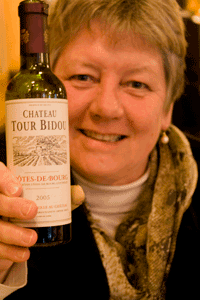
2005 Chateau Tour Bidou From the Cote de Bourg which is on the right bank of the Dordogne, adjacent to the Gironde. Wines are noted for their strong tannins and this one typifies that. A powerful wine probably made up of Cabernet Sauvignon, Merlot and Malbec. Strong cassis and berry flavours, vanillan oak tannins. Very pleasant. We drank a half bottle with lunch at a bistro. Denice had a Parisian hot dog - worth trying - and I had a steak. It went well with both. |
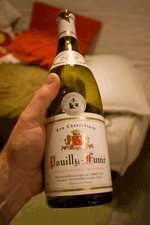
2009 Les Chantebines Pouilly Fume A wine by Alain Pabiot from Pouilly-sur-Loire in the Loire Valley, south of Paris near Bourges. A Sauvignon (Blanc) with a restrained and slightly sweet palate. The wine won a silver medal in the Concourse de vin de Val de Loire and thoroughly deserved it. I bought it at the local supermarket. €12. Excellent value. |
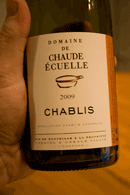
2009 Domaine de Chaude Ecuelle Chablis Chablis is always made with Chardonnay grapes. It is part of the Bourgogne (Burgundy) region and Chablis are considered to be the best of the region's whites. This wine is typical of the area with an elegant nose of a little citrus and a lean mineral quality (very similar to Granite Belt chardonnays). Mouth-filling fruity flavours on the palate. Very good and great value. €11 |
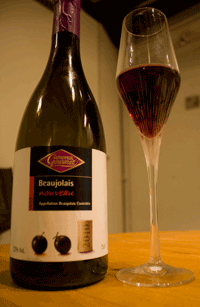
2010 Monoprix Gourmet Beaujolais Nouveau The Bueaujolais region is south of Burgundy and just north of Lyon in central/southern France. Each year, around November, there is a rush for the current vintage Beaujolais wines, noted for their light freshness. It is a style I have never liked and have always felt that you have to drink them freshly bottled because they are awful when left to exhibit their true nature. For a bit of fun and because it is that time of year, I purchased a supermarket homebrand Nouveau Beaujolais from Monoprix, expecting to be thoroughly underwhelmed. I was surprised by its fresh, clean aromas and cheerful, not-too-sweet palate. Presumably Gamay grapes. A very pleasant lunchtime wine which we drank with a wonderful pate of Rabbit noisettes and pork force meat, accompanied by fig chutney, the former purchased from an excellent butcher/deli in Rue Bretagne, the latter from a market stall in the same street. French producers should be concerned. From the looks of it their supermarkets are vertically integrating in the way that Australian ones already have - buying bulk wine or contracting its making, bottling it with their own labels and selling cheap. This one cost €4 - good for consumers in the short term, until economics drives producers to aggregate. For grapegrowers and wine makers, that must be a heartbreak rate. Anyway, it was good. |

2008 Domaine Chapelle & Fils Bourgogne Pinot Noir from Domaine Chapelle of Santenay, north east of Tours with grapes acquired from the Bourgogne region (Burgundy). Inexpensive and not very good. Thin and ungratifyingly tannic. The sort of French wine that Australians often talk about for some strange reason. INFO ON CHAPELLE & FILS €9. |
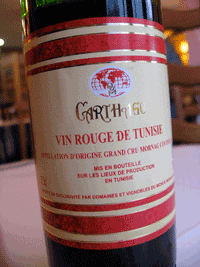
2006 Carthage Vin Rouge de Tunisie We had this remarkable wine at lunch in a Tunisian restaurant in Paris's Latin Quarter. A grand cru wine with the Mornag appelation. Interesting. Tasted like a Shiraz Cabernet Sauvignon blend with big fruit and lovely flavours. Haunting nose of berries and vanillan oak and something we couldn't quite identify on the palate - leather? Good, mysterious wine. €14 for a half bottle restaurant price. Worth looking out for. |
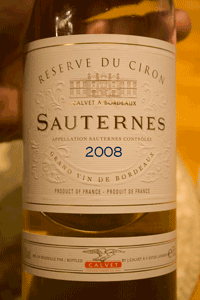
2008 Reserve Du Ciron Sauternes Our first Sauternes of the trip and a good one. From the Calvet stable, in the Bordeaux region. The town of Sauternes is about 40 kilometres south of Bordeaux. This wine is made at Landiras, just north of there and made from fruit from the district. It consists of Semillon, Sauvigon (Blanc) and Muscadelle - one source suggests 80%, 15% and 5% respectively and that would capture the palate. Floral, citrus, honey and guava fragrances and traces of Botrytis. Light but elegant citrus flavours with a little oak to finish, which lengthens the palate. Lovely and perhaps not as heavy as some examples of the region. Notably, there is none of the amazing peach kernel flavours - well, perhaps just a hint - of the famous Chateau d'Yquem wine, grown and made about three kilometres south east of Landras. However, I think the Muscadelle influence in this wine is lovely. After it has breathed well the overall impression is of a fine, light orange marmalade. We purchased this in the duty free store at Gare Nord on the way to the UK on the Eurostar. Good value at €18. |
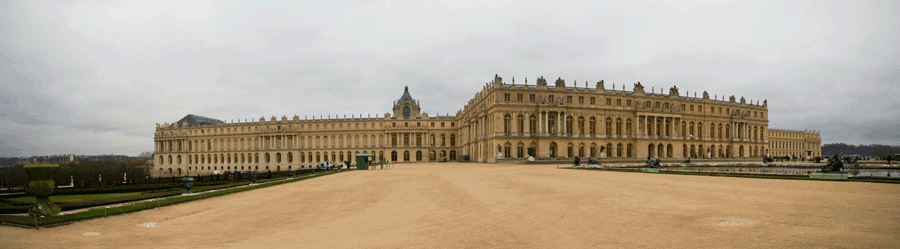
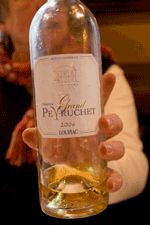
2006 Chateau Grand Peyruchet The Reserve du Ciron may have been our first Sauternes but it wasn't our first sweet wine. We had a glass of Chateau Grand Peyruchet on a visit to Versailles (above) at a wonderful restaurant there called Le Limousin. The Peyruchet comes from east of Bordeaux and well outside of the Sauternes appellation. It is a beautiful wine - a blend of Semillon and Sauvignon, full and sweet with some haunting citrus and peach flavours. I did not make full notes but this is worth looking for. We paid restaurant rates of €4.50 a glass. |
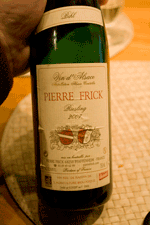
2007 Pierre Frick Riesling From the Alsace region of north eastern France, bordering Germany. We purchased this from the local supermarket and it was lovely, though it needed to breath. Classic kerosene traces on an otherwise citrus and floral nose. It had the characteristic restrained flavours of the French Riesling with excellent complexity. Cheap and cheerful. €11.
|
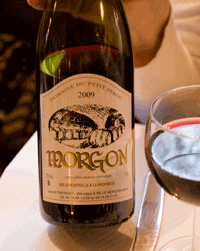
2009 Domaine du Petit Perou This wine was the biggest surprise of the trip to date. When I ordered it at a restaurant I didn't recognise what I was purchasing - that is why I bought it, in fact. It turned out to be one of the princes of the Beaujolais. Laurant Thevenet produces this wine in the Morgon area, which is, I now learn, considered to represent the best wines of the region, made with Gamay grapes (but perhaps not exclusively). The label was unhelpful. I thought I detected traces of Shiraz. This wine is big and mouthfilling. What a surprise. Violets and cherries on the nose with a raspberry palate and charry, complex oak. Beautiful and will keep for years, which I would not expect of a Beaujolais. There you go. Restaurant price €26.
|
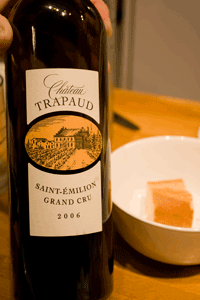
2006 Chateau Trapaud A Grand Cru wine from Saint-Emilion, east of Bordeaux and within the region. The bottle says 70% Merlot, 20% Cabernet Franc and 10% Cabernet Sauvignon - typical of the area and so different from the Medoc. Big and mouthfilling with typical mulberry-like Merlot fruit and more complex than most Australian Merlots. The Cabernet Franc lengthens the palate. Very dry but a pleasing and elegant fruit sweetness present. Like a few of France's best wines this one uses berries that have been sorted on a table at harvest, with rejects going to lesser wines. This is something not done, to my knowledge, in Australia, probably because we cannot command prices to justify the labour. The wine has had minimal filtration - this maximises flavour but it will produce tartrate crystal residues with age. The label says nothing about the type of oak but it is clearly French with a large percentage of new barrels. The label does say 75% barriques (220 litres barrels) and 25% cuvee (meaning tank, I think). The label also says that this will drink from 2011. Indeed, the tannins are furry at the moment and, in my view, it will drink best in about 4 years time. Very smooth and pleasing even now. Very impressive. Yum. €34. |

| My daughter has chastised me for not spending enough on the wines we are drinking! I am not sure what to say. It is certainly possible to spend a great deal more, especially for back vintages but is it necessary when "best of type" wines can be purchased relatively cheaply? What purpose does this serve? With the Australian dollar at record highs, this is a good time to sample French wines and, I think it also confirms the view I have held for sometime that good French wines are excellent value. Emily, I am doing my very best to spend your inheritance. Do me a favour and let me stretch it out a bit. Merci beaucoup. |
I'm using a counter on this page provided by digits counter.